

Clinical Diagnostics Market Forecast 2026–2036: Market to Reach USD 155.9 Billion by 2036 at 5.5% CAGR
Clinical Diagnostics Market
DE, UNITED STATES, March 25, 2026 /EINPresswire.com/ --
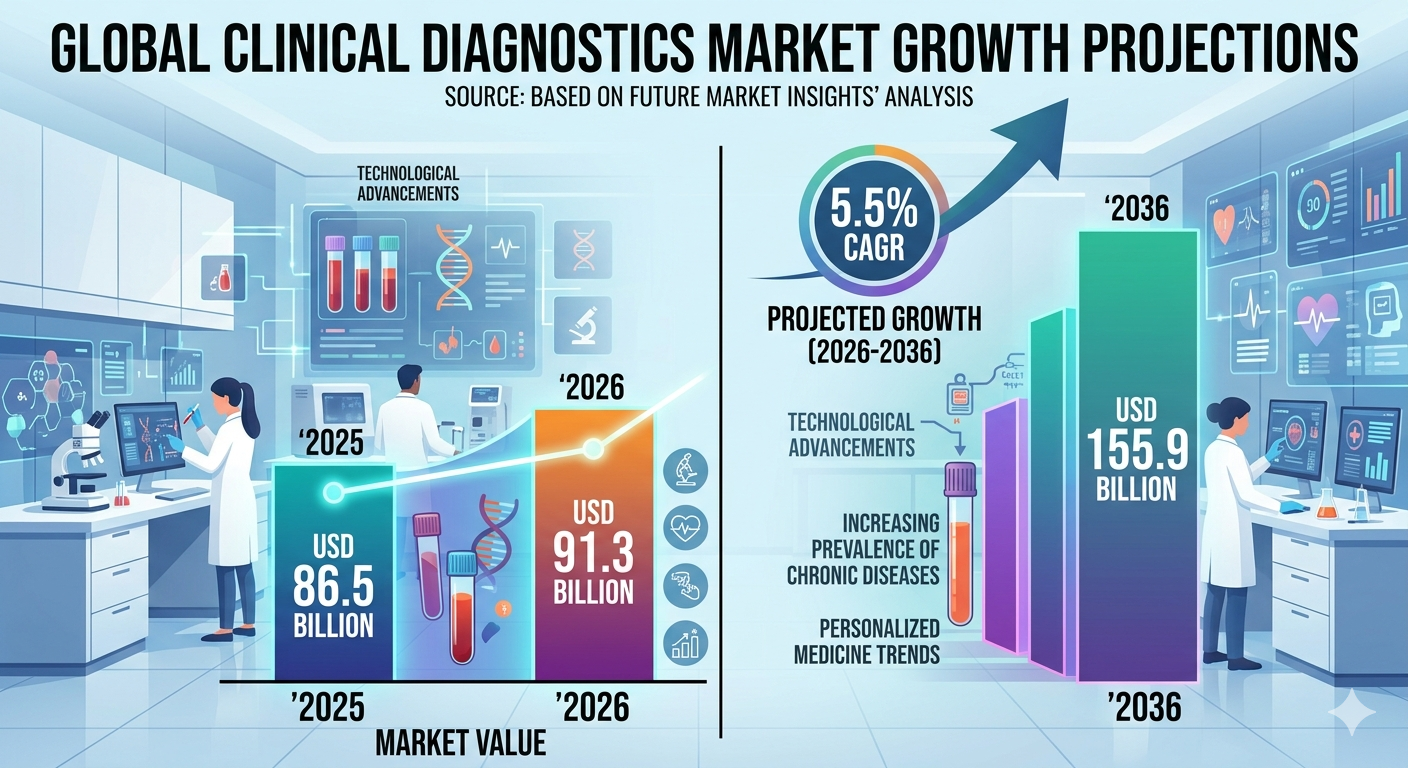
The Clinical Diagnostics Market, valued at USD 86.5 billion in 2025, is projected to reach USD 91.3 billion in 2026 and expand to USD 155.9 billion by 2036, according to Future Market Insights (FMI). The market is expected to grow at a CAGR of 5.5% over the forecast period, driven by rising chronic disease prevalence, aging populations, and rapid integration of molecular diagnostics into clinical workflows.
Sustained expansion reflects increasing diagnostic volumes, advancements in next-generation sequencing (NGS), and the growing role of liquid biopsy and AI-enabled diagnostics. These innovations are reshaping clinical pathways, enabling faster, more accurate disease detection and personalized treatment strategies.
Market snapshot: global market 2026 - 2036
Market size 2026: USD 91.3 billion
Market size 2036: USD 155.9 billion
CAGR (2026–2036): 5.5%
Leading product segment: Reagents and kits (63.3% share in 2026)
Leading test segment: Infectious disease (38.6% share in 2026)
Key growth regions: United States, China, India, Europe
Market Momentum (YoY Path)
The Clinical Diagnostics Market is on a steady upward trajectory. From USD 86.5 billion in 2025, the market reaches USD 91.3 billion in 2026, reflecting strong near-term demand. By 2028, continued adoption of molecular diagnostics and automation supports incremental gains. Growth accelerates through 2030 and 2031 as liquid biopsy and AI-assisted tools expand clinical utility. By 2033, increasing test volumes from chronic disease monitoring further strengthen revenues, culminating in a projected USD 155.9 billion market size by 2035, maintaining momentum into 2036.
Why the Market is Growing
Growth in the Clinical Diagnostics Market is primarily driven by the rising burden of chronic diseases such as diabetes, cardiovascular conditions, and cancer, alongside a rapidly aging global population. Continuous monitoring and early detection requirements are significantly increasing diagnostic demand.
Technological advancements—including molecular diagnostics, NGS, point-of-care testing, and AI-based solutions—are improving diagnostic accuracy, speed, and accessibility. Additionally, the expansion of personalized medicine and decentralized testing models is reinforcing long-term market growth.
Segment Spotlight
Product Type: Reagents and Kits (63.3%)
Reagents and kits dominate the Clinical Diagnostics Market, accounting for 63.3% of the market share in 2026. These components are essential across nearly all diagnostic procedures, including immunoassays, molecular diagnostics, and clinical chemistry. Their recurring usage across testing platforms ensures sustained demand and revenue generation.
Test Type: Infectious Disease (38.6%)
Infectious disease testing leads with a 38.6% share in 2026. The ongoing global burden of diseases such as tuberculosis, HIV/AIDS, hepatitis, malaria, and emerging viral threats continues to drive demand for rapid and accurate diagnostics. The need for outbreak prevention and timely intervention reinforces this segment’s dominance.
End Use: Hospitals and Diagnostic Laboratories
Hospitals, diagnostic laboratories, and point-of-care settings represent the primary end users. Increasing hospital infrastructure investments and expansion of diagnostic networks are supporting widespread adoption of advanced diagnostic technologies.
Drivers, Opportunities, Trends, Challenges
Drivers
The increasing prevalence of chronic diseases and a growing aging population are major growth drivers. Regular diagnostic testing for disease monitoring and early detection is becoming essential, significantly boosting market demand.
Opportunities
The rise of personalized medicine and point-of-care testing presents strong growth opportunities. Advances in genetic testing, biomarker discovery, and liquid biopsy technologies are enabling more targeted and individualized treatment approaches.
Trends
Technological innovation remains a defining trend. The adoption of molecular diagnostics, NGS, AI-driven tools, and laboratory automation is enhancing diagnostic efficiency, accuracy, and scalability. Home-based and remote monitoring solutions are also gaining traction.
Challenges
High costs of advanced diagnostic equipment and complex regulatory frameworks pose significant challenges. Stringent approval processes and high capital investment requirements can limit adoption, particularly in resource-constrained settings.
Competitive Landscape
The Clinical Diagnostics Market is highly consolidated, with Tier 1 players accounting for 55.4% of the global market share. Leading companies such as Roche Diagnostics, Abbott Laboratories, Thermo Fisher Scientific, and Siemens Healthineers maintain strong positions through extensive product portfolios, global reach, and continuous R&D investments.
Tier 2 players, including Danaher Corporation, Bio-Rad Laboratories, Becton, Dickinson and Company, Quest Diagnostics, and bioMérieux, contribute 27.2% of the market, focusing on niche segments and competitive pricing strategies. Strategic collaborations, geographic expansion, and innovation remain key competitive approaches across all tiers.
Full Market Report available for delivery. For purchase or customization, please request here: https://www.futuremarketinsights.com/reports/sample/rep-gb-15207
Scope of the Report
Market size and forecast: USD 91.3 billion (2026) to USD 155.9 billion (2036)
Segmentation: Product type, technology, test type, and end user
Regions covered: North America, Latin America, Europe, East Asia, South Asia, Oceania, Middle East and Africa
Countries covered: United States, China, Germany, Japan, India, United Kingdom, France, South Korea, Brazil, Australia, and others
FAQ
How large is the Clinical Diagnostics Market in 2026?
The market is estimated at USD 91.3 billion in 2026.
What will the market size be by 2036?
The market is projected to reach USD 155.9 billion by 2036.
What is the expected CAGR?
The market is expected to grow at a CAGR of 5.5% between 2026 and 2036.
Which technology segment is growing fastest?
Molecular diagnostics is the fastest-growing segment, driven by liquid biopsy adoption and NGS expansion.
Which country is growing fastest?
China is the fastest-growing market due to hospital laboratory modernization and domestic IVD expansion.
Explore More Related Studies Published by FMI Research:
Clinical Diagnostics Verification Panels Market:https://www.futuremarketinsights.com/reports/clinical-diagnostics-verification-panels-market
Clinical Immunodiagnostics Market: https://www.futuremarketinsights.com/reports/clinical-immunodiagnostics-market
Clinical Documentation Integrity Automation Market: https://www.futuremarketinsights.com/reports/clinical-documentation-integrity-automation-market
Clinical Data Provenance Management Market: https://www.futuremarketinsights.com/reports/clinical-data-provenance-management-market
About Future Market Insights (FMI)
Future Market Insights, Inc. (FMI) is an ESOMAR-certified, ISO 9001:2015 market research and consulting organization, trusted by Fortune 500 clients and global enterprises. With operations in the U.S., UK, India, and Dubai, FMI provides data-backed insights and strategic intelligence across 30+ industries and 1200 markets worldwide.
Why FMI: Decisions that Change Outcomes- https://www.futuremarketinsights.com/why-fmi
Contact Us:
Future Market Insights Inc.
Christiana Corporate, 200 Continental Drive,
Suite 401, Newark, Delaware – 19713, USA
T: +1-347-918-3531
Website: https://www.futuremarketinsights.com
LinkedIn| Twitter| Blogs | YouTube
Have a specific Requirements and Need Assistant on Report Pricing or Limited Budget please contact us - sales@futuremarketinsights.com
Sudip Saha
Future Market Insights Inc.
+1 347-918-3531
email us here
Legal Disclaimer:
EIN Presswire provides this news content "as is" without warranty of any kind. We do not accept any responsibility or liability for the accuracy, content, images, videos, licenses, completeness, legality, or reliability of the information contained in this article. If you have any complaints or copyright issues related to this article, kindly contact the author above.
